
Photo credit: Wines of BC
Eight BC wines that reveal why there’s more to this grape than easy drinking and affordability
British Columbia is increasingly embracing its cooler-climate potential, and the wines are beginning to reflect it. Our identity may ultimately be based more on diversity than any signature variety or style, but the success of grapes that thrive in cooler conditions is particularly noteworthy.
Typically, that means talking about Chardonnay, Pinot Noir, Riesling or Cabernet Franc. But another variety continues to carve out a niche in BC—and it may not be immediately obvious why.
Beaujolais Nouveau, officially released on the third Thursday of November, is the famously fresh and fruity expression of Gamay Noir. So, with Nouveau arriving on November 19 this year, I’m taking advantage of the occasion to ask a more local question: just what is Gamay doing in British Columbia?
The BC Wine Grape Council’s 2022 acreage report recorded 256 acres of Gamay Noir. Between 2008 and 2022, plantings increased by 44%, outpacing the average growth of red varieties over the same period. Then came the damaging cold events of late 2022 and early 2024.
The latest provincial report, based on production-insured vineyards, records 243 acres of Gamay in 2026. The methodology differs from the earlier survey, so the figures aren’t directly comparable, but the direction is notable: Gamay remains sixth among BC’s red wine varieties and its reported acreage sits remarkably close to its pre-freeze level.
Gamay Noir is forever associated with Beaujolais, immediately south of Burgundy’s Mâconnais, where the grape can shapeshift from the exuberantly fruity wines of Beaujolais Nouveau to structured, complex cru Beaujolais capable of long-term ageing. There are similarities to Pinot Noir in its red-fruited and floral character, but Gamay generally brings naturally refreshing acidity, modest alcohol and relatively low tannin. Crucially for a cool-climate wine region, it also ripens relatively early.
Those characteristics seem particularly well aligned with where wine is heading. Freshness, moderate alcohol and lighter extraction have found receptive audiences, while Gamay can occupy some of the stylistic territory that has made Pinot Noir so desirable—often at a considerably more approachable price.
But is affordability really the most compelling argument for Gamay? Or does the grape offer something distinctive enough to warrant greater attention on its own?
Gamay has long struggled with perception. Jancis Robinson has described the famously youthful wines of Beaujolais Nouveau as “precocious,” while Natalie MacLean invokes the “Rodney Dangerfield” effect: Gamay, she jokes, gets no respect. Decades of association with inexpensive, simple Beaujolais Nouveau haven't always helped its case.
Canadian wine competitions share a different perspective.
Gamay has its own category at both the National Wine Awards of Canada and the All Canadian Wine Championships. Ontario remains the centre of Canadian Gamay production, but BC is increasingly making its presence felt. At the 2026 National Wine Awards, 43 Gamays were entered and more than 80% received a medal. The six Golds awarded were evenly split between Ontario and British Columbia.
Perhaps Gamay is getting some respect after all.
Then there is the question of terroir. Arguably more so than any other grape, Gamay is touted as being most suitable for one particular soil type, and that is granite. The connection has merit: some of the region’s most celebrated vineyards sit on granitic soils, and Gamay has demonstrated a particular affinity for them. But that doctrine becomes less useful when trying to understand Gamay in British Columbia.
BC encompasses a remarkable diversity of soils, parent materials, elevations and microclimates. Trying to identify our closest approximation of Beaujolais risks asking the wrong question. BC does not need to reproduce Beaujolais for Gamay to succeed here. More interesting is what happens when the variety encounters our own collection of sites—and whether something recognizably British Columbian emerges from them.
So I assembled eight BC Gamays, spanning three vintages and several growing regions, to see what the wines themselves might reveal. There was a familiar foundation of red fruit, bright acidity and generally modest tannins, but the similarities only went so far. Some were fresh, fruity and immediately approachable. Others offered savoury complexity, concentration and a surprising degree of structure. The best examples found balance without sacrificing individuality.
BC can clearly grow excellent Gamay. But why should it?
It can be delicate or generous, playful or serious, and seems particularly well suited to the direction BC wine is taking: wines defined by acidity, balance and character rather than sheer power.
I wouldn't suggest that BC has discovered a singular expression of Gamay. But Gamay undoubtedly gives BC another way to express itself.
And for a wine region whose identity may ultimately be defined by diversity, that seems like a very good reason to keep growing it.
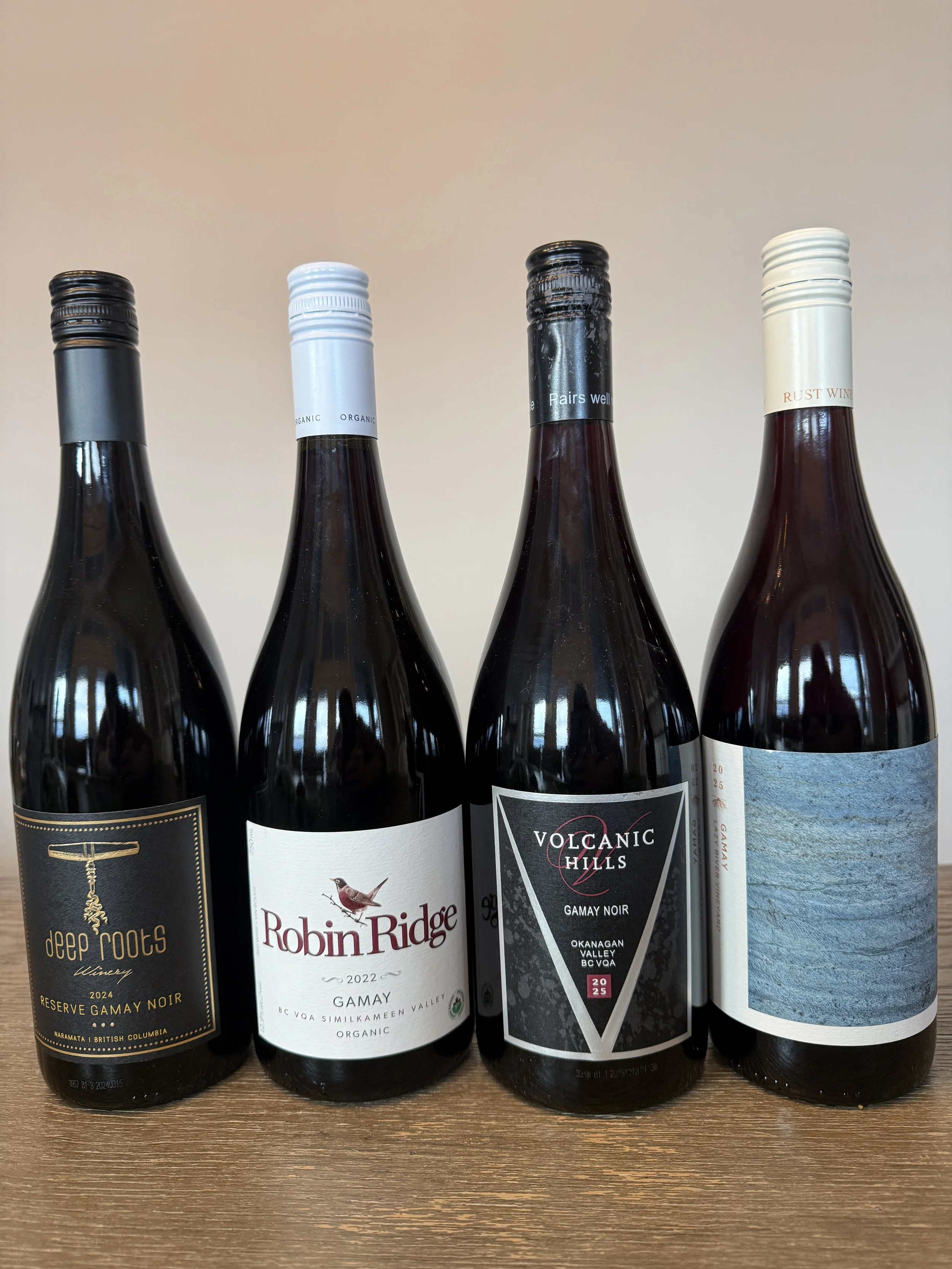
Deep Roots Winery 2024 Reserve Gamay
Only one estate wine was produced at Deep Roots in 2024, and this was it. Fruit comes from the Hardman vineyard in Naramata, sloping southwest towards Okanagan Lake. Aged in neutral oak for 8 months, the three best barrels were selected for the Reserve label. A deep crimson, this Gamay combines ripe red fruit and boysenberry with the homey comfort of Eccles cakes and cedar spice, with a gentle lift of volatile acidity. There is plenty of freshness and more prominent silky tannin structure, hedonistic texture, and a long and concentrated finish of ripe berries and spice.
Robin Ridge Winery 2022 Gamay
Robin Ridge is an organic producer in the Similkameen Valley. Their 2022 Gamay is aged 10 months in French and Hungarian oak, 11% new. On the darker end of the fruit spectrum, with aromas of blueberry, stewed plum, chocolate-covered cherries, red apple, oak spice, and smoke. The palate has great energy and freshness, with lively acidity, low tannins, and a nicely concentrated finish. Well suited to game or grilled lean meats.
Volcanic Hills Estate Winery 2025 Gamay Noir (Gold, National Wine Awards of Canada; Gold, Cascadia International Wine Competition)
Volcanic Hills planted Gamay on two West Kelowna vineyards back in 1990 and 1992. Produced with minimal oak treatment and partial carbonic maceration, this Gamay puts bright, intense fruit up front in a very approachable style. Ripe red berries and potpourri lead while black cherry yogurt provides mid-palate support along with juicy acidity and subtle tannin structure. A whisper of spice emerges on the long, fruity finish.
Rust Wine Co. 2025 Gamay (Silver, National Wine Awards of Canada)
This Gamay is sourced from the Similkameen Valley’s Lazy River Vineyard, with vines planted 30 years ago. The wine is aged 6 months in neutral oak barrels. The aromatics are distinctive, swirling with brilliant cherry, boysenberry, dried leaves and pine needles. There’s an herbaceous and stemmy thread for sure, also displaying a reductive rubber note. Flavours are precise and well concentrated, framed with vibrant acidity and inconspicuous tannins, finishing with bright red fruit and woody spice.
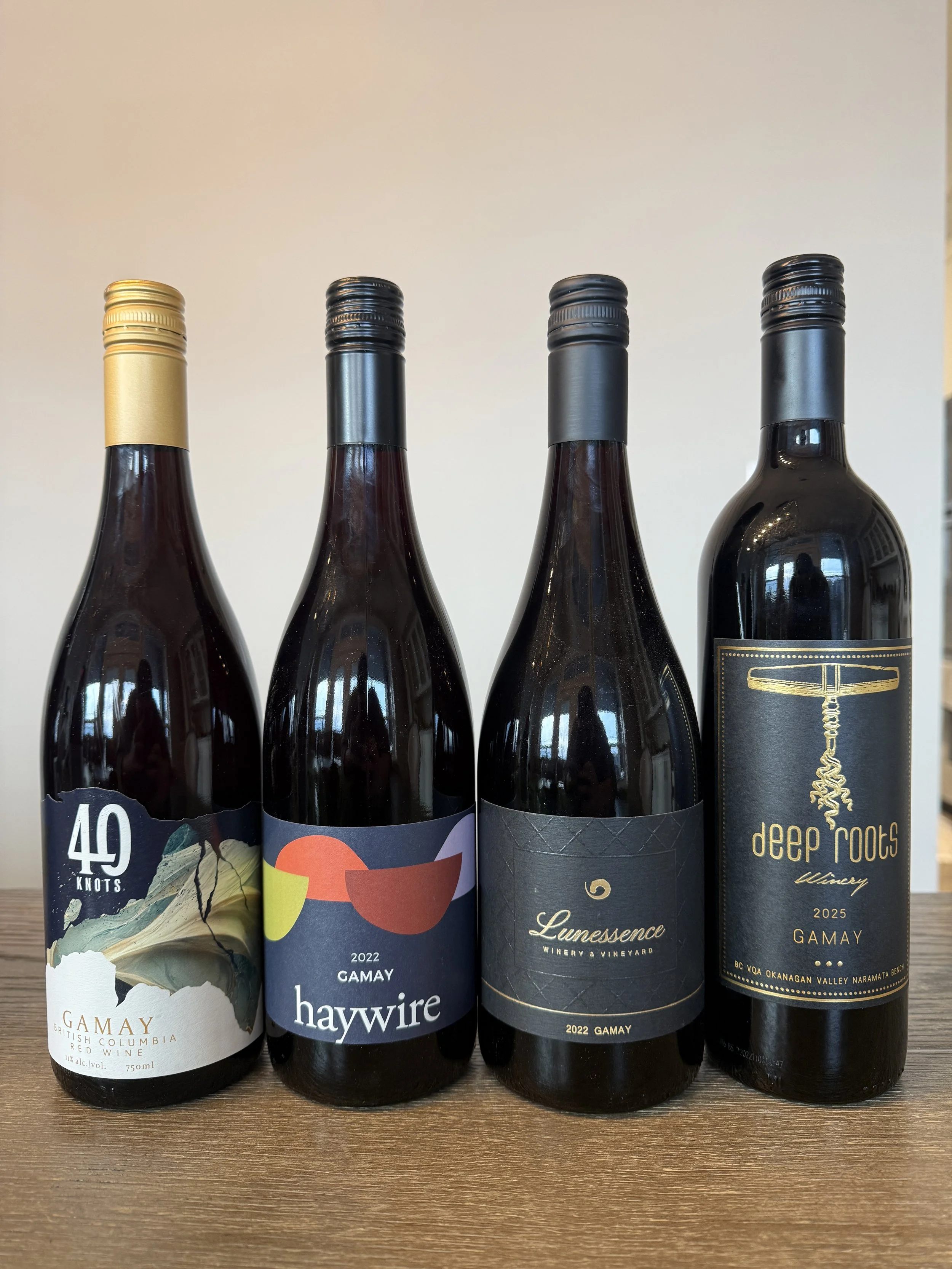
40 Knots Winery 2022 Gamay
Grown in Comox by the sea and aged in stainless steel, this Gamay is starting to show some maturity but remains remarkably vibrant and bracing. Savoury rosehip, wet leaves, mushroom, and spice are well integrated with raspberry and cranberry aromas. The palate bears 40 Knots’ signature searing acidity, and offers gentle tannin, further savoury balance, and a raspberry vinaigrette finish. 40 Knots was recently acquired by K’ómoks First Nation, making it Canada’s second indigenous-owned winery.
Lunessence Winery & Vineyard 2022 Gamay
Lunessence’s Black Label wines are made from non-estate fruit sourced from grower partners. This Gamay comes from a vineyard close to the winery, on Summerland’s lakeshore. The fruit is hand sorted and foot trodden and undergoes native fermentation. The wine is matured in neutral French and American oak, and is bottled unfined and unfiltered. The nose presents a warm cherry turnover dusted in cinnamon, along with delicate florals. Soft, rounded acidity and gentle tannins provide cozy structure for the ripe fruit flavours. Concentration is modest, and the finish cleanly balances potpourri, spice, and dried cranberry. Gentle, fun, and a little funky.
Haywire Winery 2022 Gamay
50% whole clusters are used here, fermenting in a combination of open-top tanks and concrete vessels. This Gamay is restrained and subtly expressive, red-fruited along the lines of cranberry and cherry, with some English garden florals and leafy herbs, and a warmth like freshly baked Christmas cake. Tannin presence is steady and soft, there’s fine acidity, and the finish carries dried red berries and cola.
Deep Roots Winery 2025 Gamay
Sourced from Hardman Vineyard on their Naramata estate, this Gamay is aged 8 months in 2- and 3-year old barrels. Cherry pie, baked strawberry, and oak spice aromas lead into a concentrated and fruity palate where bright acidity and firm but velvety tannins contribute to a very fine textural experience. The finish echoes with red and black fruit and warm spices.
Blog post written by: Matt Tinney, Contributor, uncorkBC