
Photo credit: Katelyn Bauer
Six unmarked glasses, thirty seats and three Cowichan winemakers. A blind tasting that asked whether Vancouver Island Pinot Noir can stand beside Burgundy, the Yarra Valley and Central Otago.
There were six glasses of Pinot Noir in front of me, each poured from a bottle hidden inside a brown paper bag. Nobody in the room knew which wines were from the Cowichan Valley and which had travelled from the other side of the world. We did not even know which other regions were in the lineup. That was the point.
The seminar, hosted by Tourism Cowichan at the Victoria International Wine Festival (November 6 and 7, 2026), carried a title that has stayed with me ever since: Beauty in the Margins. It was a small room, perhaps thirty people at most, which made it feel less like a lecture and more like a conversation. You could ask a question and have three winemakers answer it.
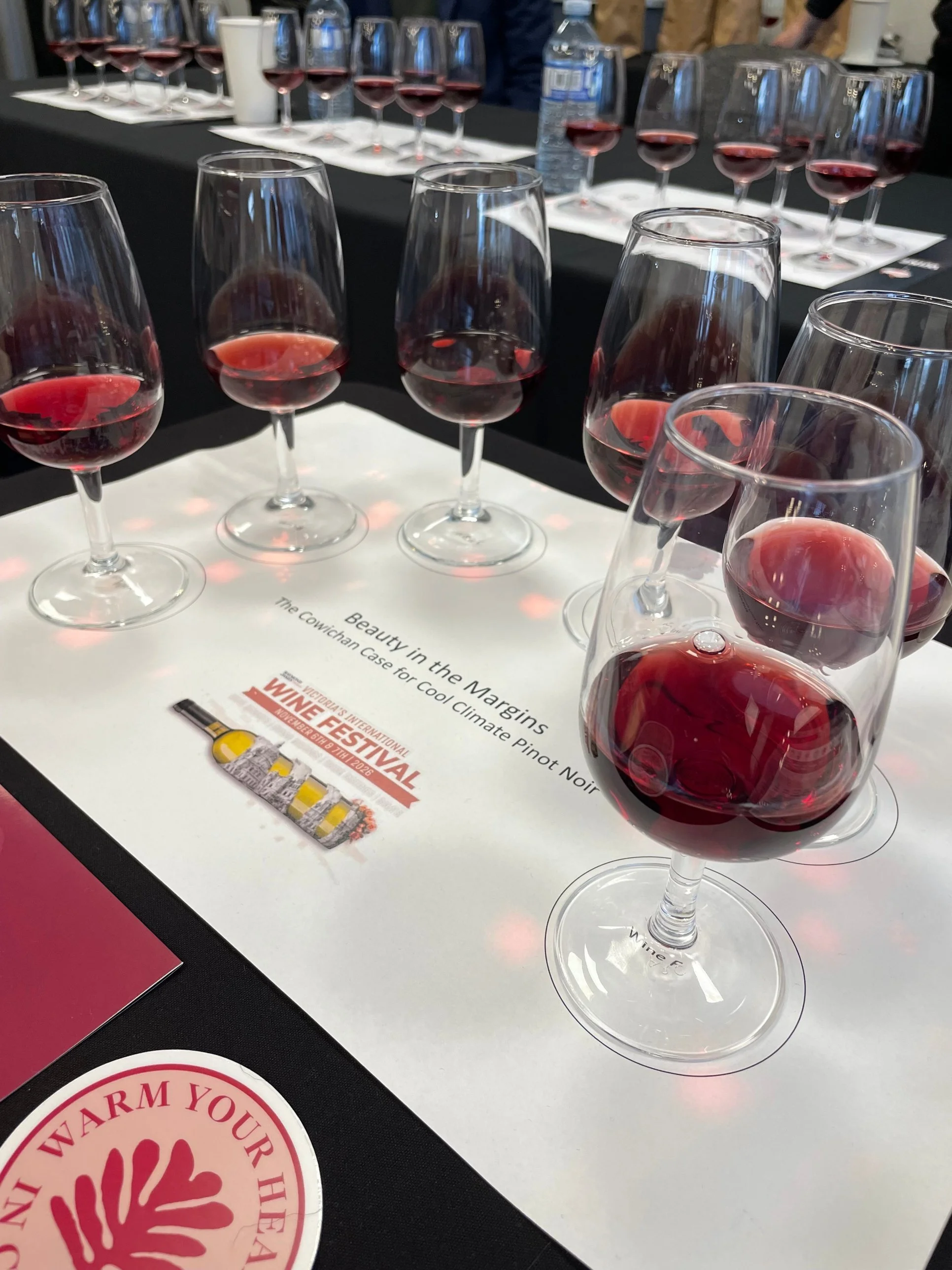
Brown bags on the back table, six glasses on the mat and nothing to give the game away.
What does it mean to grow in the margins?
In wine, the margin is the edge of where a grape can ripen at all. Plant a variety too close to the poles, or too high up a mountain, and the fruit never quite gets there. Plant it somewhere too warm and it ripens too fast, losing the freshness and perfume that make wine worth drinking.
Pinot Noir is famously fussy about this, frequently called the "Heartbreak Grape" because it is notoriously difficult and frustrating to grow, yet capable of producing some of the most magical, complex wines in the world. It is thin-skinned, early-ripening and quick to show every decision made in the vineyard and the cellar. Dylan Sheldon of Cobble Hill Winery put it simply: "Pinot Noir has always done its best work historically, right on the boundary of where it's possible to grow." Burgundy was once that boundary, and so were Central Otago and Oregon's Willamette Valley.
Why winemakers keep trying
Even after an entire season of agricultural stress or losing a crop to mould or weather, growers and winemakers persist. When everything aligns, Pinot Noir yields a wine of unmatched elegance, silky texture, red fruit notes and deep earthiness
The panel's argument was that Cowichan sits right on that line today. The growing season is short and intense. The valley is tucked into the rain shadow of the Vancouver Island mountains, so it is one of the more sheltered places to grow grapes on the coast, with the Salish Sea softening the extremes. The region is often described as Canada's only maritime Mediterranean climate: warm dry summers, mild wet winters and long cool evenings that hold onto acidity.
"There's only a small couple of places where all of their best vintages are in front of them, not behind them, and that's where we're at." – Dylan Sheldon, Winemaker, Cobble Hill Estate
That line has stayed with me. As classic regions wrestle with heat, early harvests and climbing alcohol levels, the margins are moving. A place that once seemed marginal for Pinot Noir may turn out to be exactly where the grape now wants to be. For a valley this young, that is an exciting thing to hear.
The people behind the glasses
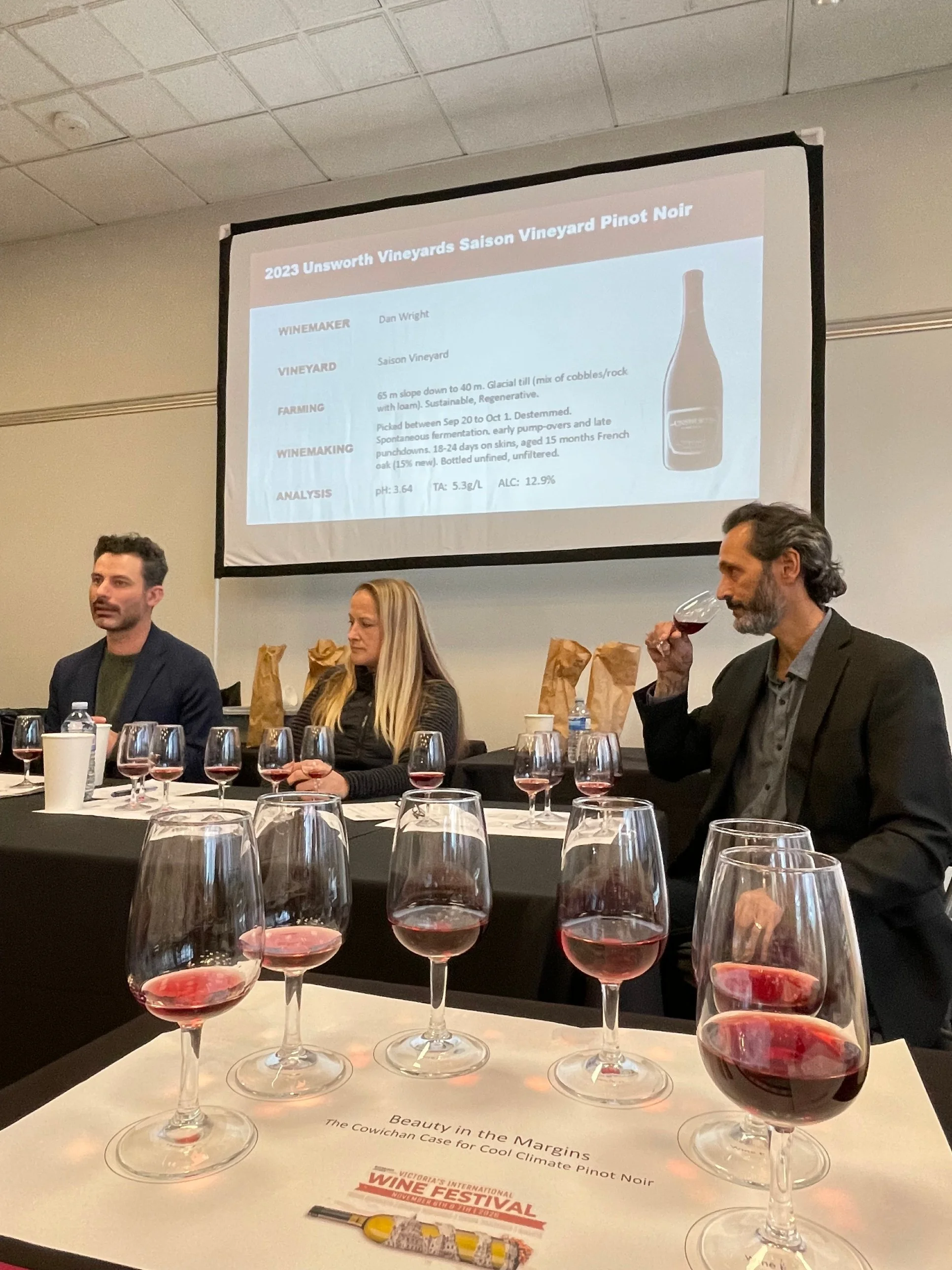
Winemakers Dan Wright (Unsworth) left, Stacy Hornemann (Blue Grouse) centre and Dylan Sheldon (Cobble Hill) right.
The panel was moderated by Gilian Handelman (Senior Vice President of Wine Education at Jackson Family Wines), who has worked as a sommelier, a winemaker, at a wine magazine and in retail. Beside her sat three Cowichan winemakers, each approaching the valley from a different vantage point.
Dan Wright has completed eleven harvests at Unsworth Vineyards. Before settling on Vancouver Island, he worked vintages in Oregon's Willamette Valley, Marlborough, Niagara and Orange in Australia, seeking out cool-climate territory where Pinot Noir could show its more delicate side. Over the past decade he has built close ties with Island growers, sourcing from single sites like the dry-farmed Saison Vineyard as well as some of the region's earliest plantings from the early 1990s.
Stacy Hornemann took the helm at Blue Grouse Estate Winery in 2024 after seven years making wine in California with Jackson Family Wines. Two years after the Jackson family bought Blue Grouse, they tapped Stacy to relocate from Sonoma to lead it. Stepping directly into her first Island harvest during a challenging, rainy autumn, she leaned on stainless steel and porous terracotta amphorae to let the vintage's natural acidity and mineral tension sing rather than masking them behind heavy oak. As she put it, butter belongs on toast, not in the glass.
Dylan Sheldon of Cobble Hill Winery brings roughly thirty vintages across both hemispheres and describes himself as a "climate refugee" who came looking for cooler ground. At Cobble Hill he grows a remarkable 27 grape varieties. His reasoning is simple: in a region this young, the only way to learn what truly belongs is to plant it and see.
Their descriptions of Pinot Noir were as vivid as the wines. Stacy asked us to imagine putting a fruit bowl outside in the rain and keeping an eye on it so the fruit wouldn't spoil or rot, while hoping for the best (that, she argued, is akin to grape growing). Gilian offered my favourite perspective: "Silky may be Pinot Noir's most important word, besides perfumed."
Six glasses, no labels
Wines A to Wine F, and a reminder to warm your heart in Cowichan.
Tasting blind strips away everything you think you know. Without a label, there is no price, no reputation and no story to lean on. There is only colour, aroma and the way the wine moves across your palate. All six glasses were translucent, pale to mid ruby, and for most of the tasting I found it genuinely difficult to tell which were from the Island.
I correctly picked one: Wine B, the Unsworth Saison Vineyard. I would love to claim a superhuman palate, though the truth is probably simpler. I have had that wine before, and something in the glass felt familiar. The rest of the room seemed to share my difficulty. The Cowichan wines were bright, fresh and red-fruited, sitting comfortably beside the international benchmarks rather than standing out as the odd ones in the lineup.
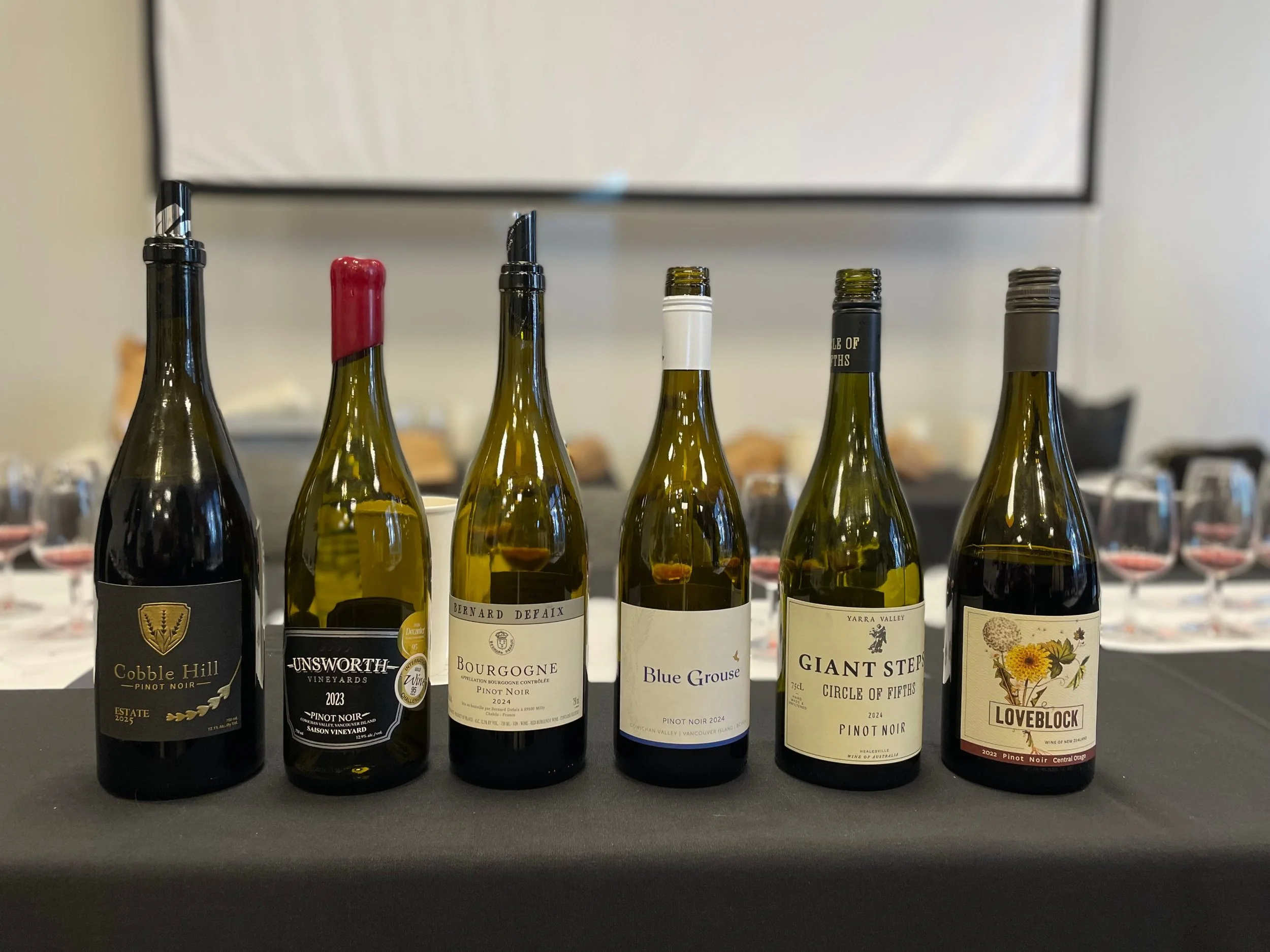
WHAT I TASTED- The blind lineup
Cobble Hill Estate Pinot Noir 2025 | Winemaker Dylan Sheldon | Cowichan Valley, Vancouver Island, BC
Unsworth Vineyards Saison Vineyard Pinot Noir 2023 | Winemaker Dan Wright | Cowichan Valley, Vancouver Island, BC
Domaine Bernard Defaix Bourgogne Pinot Noir 2024 | Burgundy, France
Blue Grouse Cowichan Valley Pinot Noir 2024 | Winemaker Stacy Hornemann | Cowichan Valley, Vancouver Island, BC
Giant Steps Circle of Fifths Pinot Noir 2024 | Yarra Valley, Victoria, Australia
Loveblock Pinot Noir 2022 | Central Otago, New Zealand
Poured blind in this order, Wine A to Wine F. The three Cowichan wines sat among Burgundy, Australia and New Zealand.
The reveal: three from Cowichan, three from around the world.
The technical slides in the presentation helped explain why these wines felt so composed. The Unsworth Saison Vineyard sits on a slope falling from 65 to 40 metres, planted on glacial till (a mix of cobbles and rock with loam left behind by retreating glaciers). The fruit was destemmed, fermented with wild yeast, aged fifteen months in French oak (only 15% new) and bottled unfined and unfiltered, at 12.9% alcohol.
Blue Grouse blended its own estate fruit, grown on silty loam with marine deposits, with grapes from the same Saison Vineyard. Stacy fermented in stainless steel and terracotta amphorae (clay vessels that let a wine breathe without adding oak flavour), then aged the wine in French and Hungarian oak (only 17% new) and amphorae. The wine came in at just 11.5% alcohol, a number that would be hard to achieve in many warmer regions.
Stacy Hornemann talking through the 2024 Blue Grouse Pinot Noir.
Dan summed up the Island style neatly: ripe fruit that never feels jammy or overripe, freshness and acidity in spades, and lower to moderate alcohol.
Specialize, or keep experimenting?
One of the liveliest moments of the seminar came when the conversation turned to identity. Should Cowichan plant its flag firmly on Pinot Noir, the way Central Otago and Oregon did? Or should it keep experimenting, as Dylan currently does with his 27 varieties?
Gilian gently pushed back, playing the part of the curmudgeon in the room: "The mark of any region that has made its way into the world most successfully is focused." Her point was that world recognition rarely comes from doing a little of everything. It comes from mastering one or two signature styles that critics and drinkers instantly associate with a place.
Dylan's answer was rooted in curiosity. In a valley that has only been growing grapes commercially for around thirty years, nobody can say yet which varieties will be truly exceptional here. His 27 varieties are not a reluctance to commit; they are an ongoing field trial. We simply won't know what Cowichan's soils, rain shadow and maritime pockets do best until someone plants it and tries.
My instinct is that the answer is both. The region is still too young to stake everything on one grape, and some of its most exciting discoveries (the varieties that turn out to be exceptional here) are probably still to come. That said, with a bit of focus and some confident storytelling, Cowichan Pinot Noir could become a name people recognize far beyond the Island. A flagship does not have to mean the end of curiosity.
"We have ripeness without it feeling jammy, freshness and acidity in spades, and lower to moderate alcohol." – Dan Wright, Winemaker, Unsworth Vineyards
A vintage guide for Island Pinot
Dan finished with something particularly useful for anyone buying Cowichan Pinot Noir: a quick tour of recent vintages. 2021 was shaped by the heat dome. 2022 began with a cool, wet spring and finished with a warm, dry fall, with picking stretching to the end of October and wines on the delicate side. 2023 was warm and easy. 2024 brought challenging rains and a mid-October harvest. 2025 was warm and early, and 2026 was the earliest yet.
His advice: reach for 2022 and 2024 if you love lighter, more delicate wines, and 2023 and 2025 if you prefer a little more structure. Keep an eye out for 2026 in a couple of years, too.
Back out on the festival floor
After the seminar, I walked out into the public tasting, where wineries from many countries were pouring side by side. It is a rare thing to have so much of the wine world in one room in Victoria. However, what struck me most were the BC tables. They consistently had lines and groups gathered, while some of the international tables were noticeably quieter.
After an afternoon spent asking whether Cowichan could hold its own against Burgundy, Australia and New Zealand, it was lovely to see the answer playing out in real time. People wanted to taste what was growing in their own backyard. Beauty in the margins, it turns out, has quite a following.
Blog post written by: Katelyn Bauer, Vancouver Island Representative, uncorkBC